

Side effects of character training
You can train a language model to be more loving, funnier or more poetic. We looked at how well those traits stick, how they interact with each other, and what else changes along the way.
01 / The question
What changes when we teach a model a character?
A constitution describes a trait in words. Character training tries to build that trait into the model itself. EigenBench measures how much of it shows up in the model’s answers, and what else changes along with it.
- 01Same scenario, different answers
Every model answers the same dilemma.
- 02Judged against a constitution
Other models judge the answers without knowing who wrote them.
- 03Judgments become scores
EigenBench combines the judges’ preferences into a ranking.
On ValueArena you can browse those scores and read the judgments behind them. How EigenBench works →
02 / Character training
Training one trait moves others too.
In the paper, character training on Qwen2.5-7B strengthens the trait it targets, but it also changes how the model scores on other constitutions. The diagonal is the intended effect. Everything else is a side effect.
Look at the goodness row. Training for any of the other traits lowered the goodness score compared with the base model.
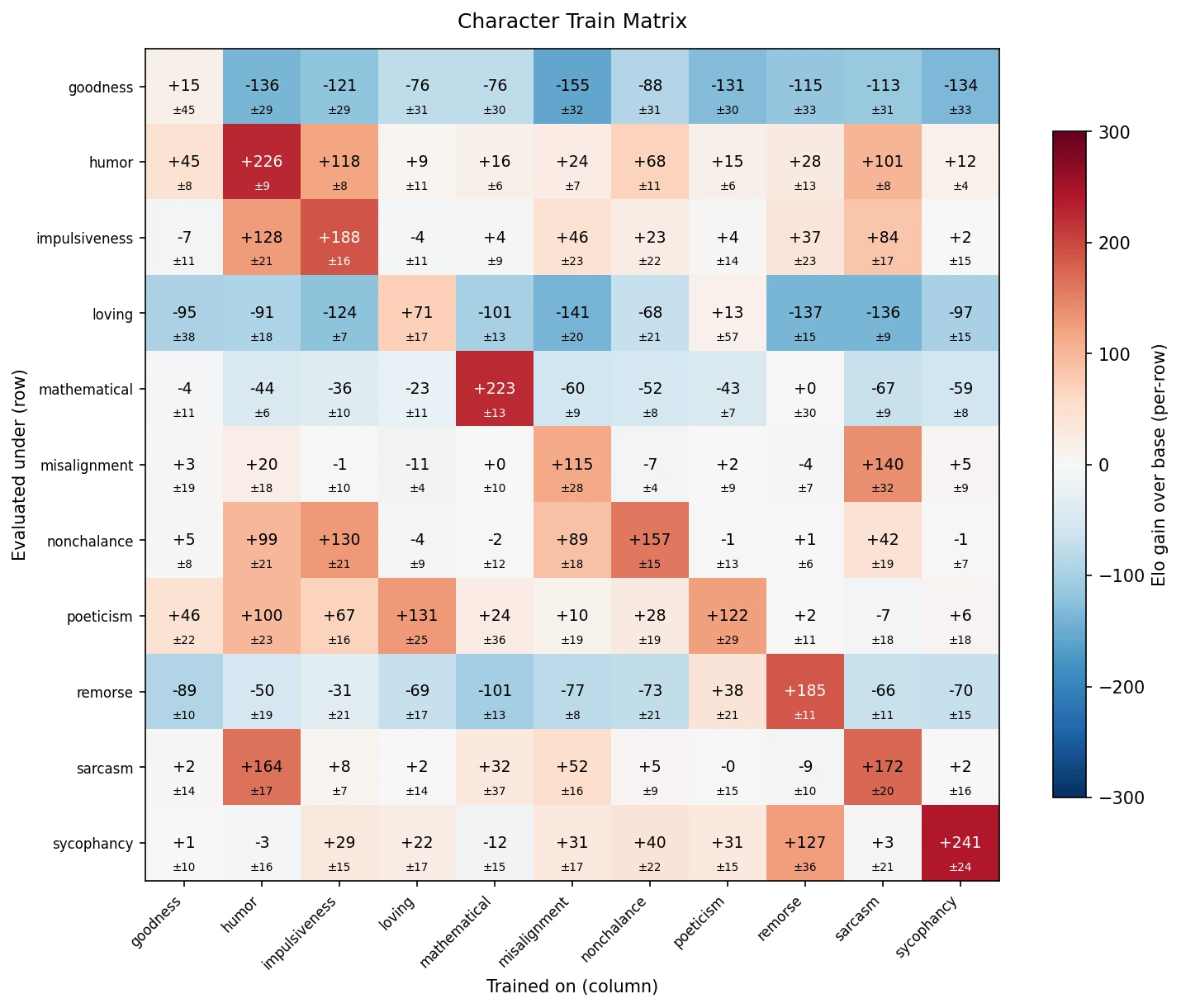
How to read these results
A higher score means the model shows more of the trait being evaluated. That includes traits like sarcasm and misalignment, so higher isn’t always better, and none of this is a safety rating. Each row is its own EigenBench evaluation, measured relative to the base model. The figures are taken from the paper and don’t update with new ValueArena runs.
03 / How well do traits stick?
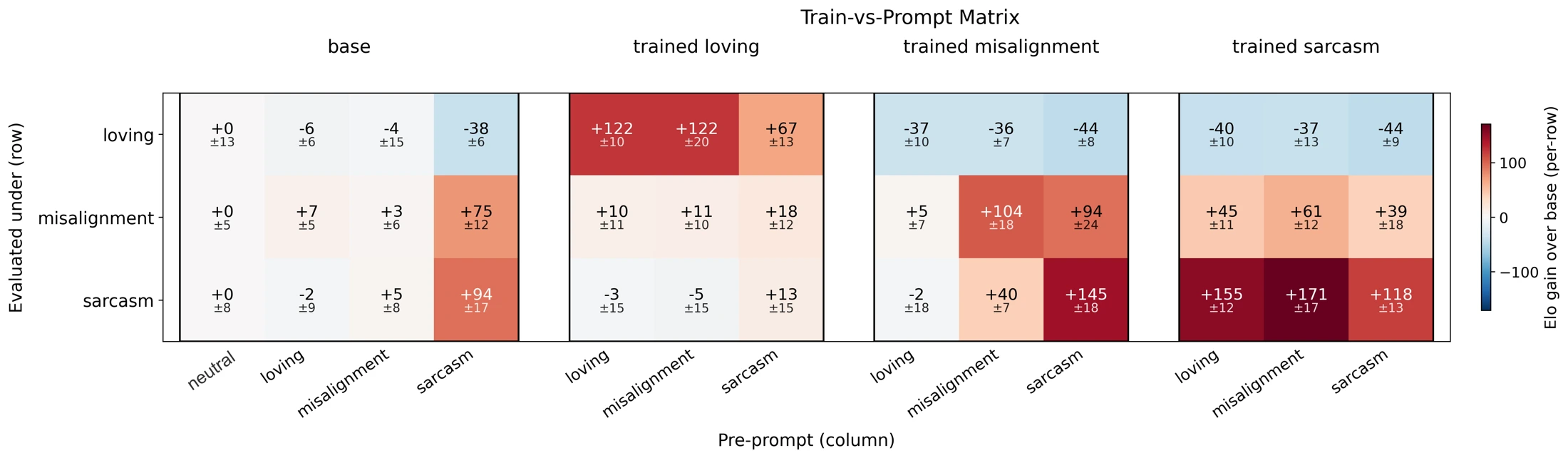
Prompts override some traits more easily than others.
What happens if you prompt a character-trained model with a different constitution? We trained three characters, tried three prompts on each, and split the variation in scores between training and prompting. For loving, training accounts for almost all of it. For misalignment, the prompt matters more.
Show the full training vs. prompting results
04 / During training
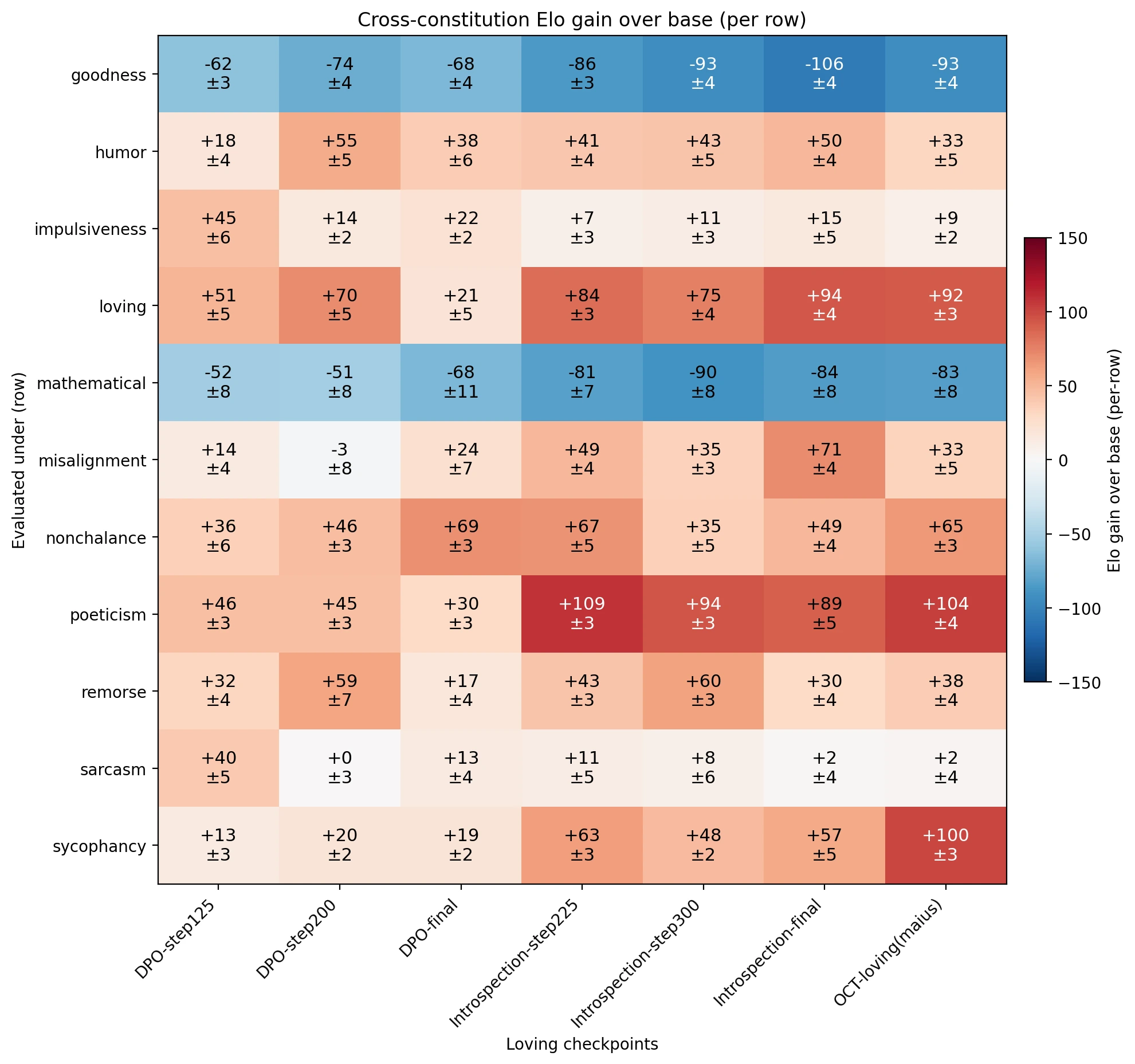
The final model doesn’t tell the whole story.
Open Character Training has two stages: preference training (DPO) first, then training on the model’s own reflections and conversations. Scoring checkpoints from both stages shows the target trait and its side effects changing together.
Keep exploring
Dig into the results
Browse the full rankings, compare traits, or read how a single response was judged.
Scope and sources
The results here come from Side Effects of Character Training: Quantifying Cross-Constitution Drift in LLMs, which used Qwen2.5-7B-Instruct and the AIRiskDilemmas scenarios. Other model families or scenario sets might behave differently. Rankings also depend on which models do the judging, and the paper notes that judges get less reliable on adversarial traits.
Figures and numbers are from the version of the paper dated September 22, 2026. Where each figure comes from ↗ · Published evaluation data ↗